Sachiko’s cottage
A Pale View of HillsSachiko’s cottage is both a domestic refuge and the setting for a decisive rupture between Sachiko and Mariko. Set beyond a dry wasteground and close to the water, it holds the ordinary details of a household preparing to leave: clothing, blankets, cherished china, and kittens. But the cottage’s narrow, shadowed interior and its exposed riverbank also make it the place where the strain between mother and daughter becomes impossible to overlook.
Setting and Approach
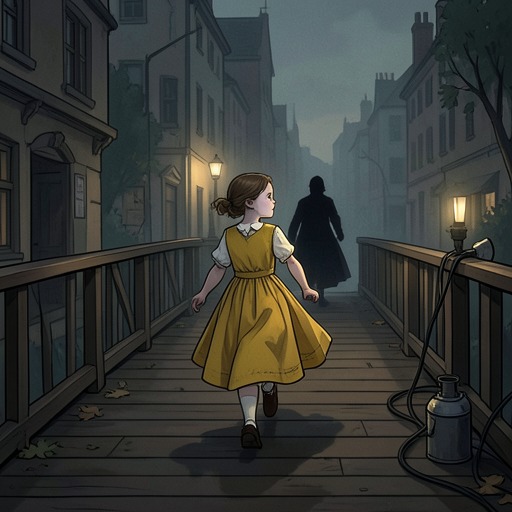
The cottage stands across the wasteground from Etsuko’s apartment. The route is short in distance but physically tiring: the dry acres have hardened enough for the Large white American car to cross them, while Etsuko finds the walk on foot exhausting. The cottage is therefore close enough to watch from her window, yet separated from her by open ground that she must deliberately cross when concern draws her there.
From the apartment, Etsuko sees a thin woman walk slowly and deliberately across the wasteground, pause outside the cottage, and disappear behind its sloping roof. An hour earlier, the Large white American car had come over the uneven ground and passed around the apartment block; glare on its windscreen kept Etsuko from seeing its occupants clearly. The cottage’s position makes it a point of arrival and observation, but not of certainty: Etsuko can see someone enter without knowing what is happening inside.
When she reaches the entrance, she hears Mariko speaking with another voice, though she cannot make out the words. She calls inside; the voices stop. After entering, she has to wait for her eyes to adjust to the darkness. The transition from the bright, hot day outside to the cool, dim room gives the cottage a distinct physical presence before its occupants come fully into view.
Interior and Domestic Life
The interior is marked by narrow shafts of sunlight falling through gaps onto the tatami and by the persistent smell of damp wood. These details make the cottage feel enclosed and worn, even when the central partitions are opened wide to admit the last daylight. Light reaches only part of the room: in the evening, the sunset coming across the veranda barely reaches the far corner where Mariko sits watching Sachiko.
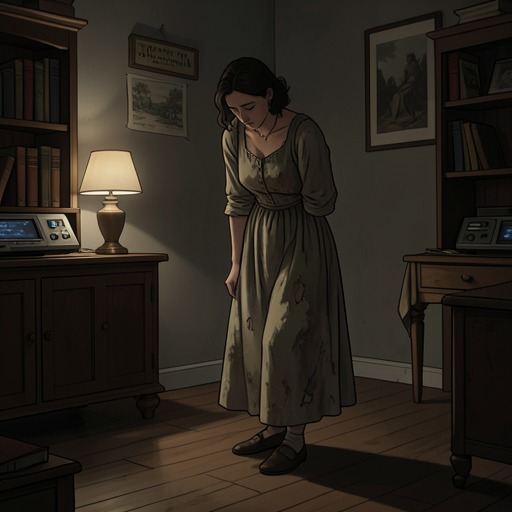
The room’s furnishings and stored possessions register the practical work of departure. Clothing, blankets, and other belongings lie scattered across the tatami. Two fine kimonos that Etsuko has never seen Sachiko wear sit beside her, while Sachiko’s delicate pale-white china tea set has been packed into a cardboard box. The cottage is still being lived in, but its familiar objects have begun to change status: the tea set is no longer simply part of the room’s domestic life but something being prepared for removal.
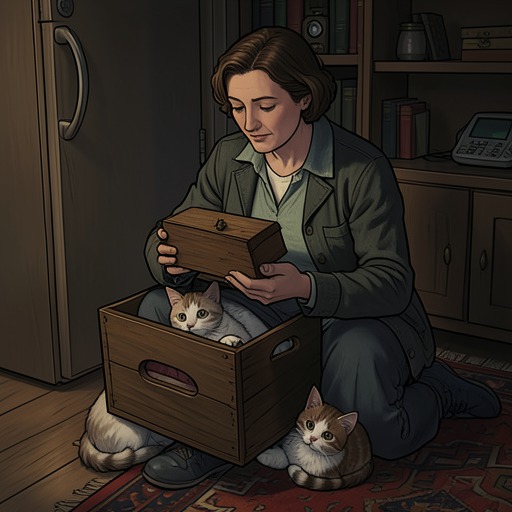
The kittens remain among these signs of unsettled domesticity. As Sachiko packs, two play together on the tatami and Mariko holds a third. The open partitions admit the fading light, but do not resolve the distance between mother and daughter: Mariko quietly watches Sachiko from the far corner, with the kittens close to her. The room brings packing, watching, and play into one confined space, so the anticipated move is present alongside the small attachments that make leaving painful.
Conflict at the Riverbank
The cottage’s relation to the water becomes central when Sachiko decides to dispose of the kittens. After Mariko insists that her mother had allowed her to keep them, Etsuko offers to come and feed them until homes can be found. Sachiko rejects the offer and calls Mariko childish and deliberately awkward. She then takes a vegetable box, turns it so that its wire-grid panels face upward, and drops the kittens into it one by one. Mariko still holds the remaining kitten when Sachiko demands that she hand it over.
The action carries the conflict from the room to the bank. Mariko turns toward Etsuko, then leaves the cottage. Etsuko initially remains still before putting on her sandals and going outside. From the doorway she sees Sachiko down by the water, the vegetable box beside her feet, and Mariko standing several yards behind her where the ground begins to slope steeply. Sachiko appears not to have noticed her daughter. The cottage’s threshold thus frames a separation within the same scene: mother and daughter are both outside, but they occupy different positions and attend to different things.
Etsuko tries to lead Mariko back to the house, but the girl keeps her eyes on her mother and does not respond. Sachiko kneels cautiously on the bank and moves the box nearer the water. The sunset comes through trees on the opposite bank, casting long shadows across the muddy ground; the grass beneath Sachiko is thick with mud. The natural setting does not soften the action. Instead, the bank’s slope and mud make the distance between the figures concrete as Sachiko approaches the water and Mariko remains behind.
Narrative Significance
The cottage connects private domestic routines to the story’s larger uncertainties about departure, care, and memory. Etsuko observes it first from a distance, then enters it to find an unfamiliar old woman sitting with Mariko, and later returns to find Sachiko preparing to leave. These visits do not make the cottage a transparent source of answers. Its dimness, interrupted sightlines, and voices that stop when Etsuko enters preserve limits on what she can know even as she becomes involved in the household’s tensions.
Its most consequential contrast is between the work of preparing belongings for travel and the treatment of the kittens that remain. The packed tea set and unfamiliar kimonos suggest that Sachiko’s departure is advancing; the kittens’ presence makes Mariko’s attachment to what is being left behind immediate. At the water’s edge, the vegetable box turns the cottage’s domestic world into an act with consequences, while Etsuko’s attempts to intervene cannot make mother and daughter move together. The cottage is therefore more than a backdrop: it is the fixed place from which departure is anticipated and the site where the conflict over what can be carried, kept, or abandoned takes physical form.